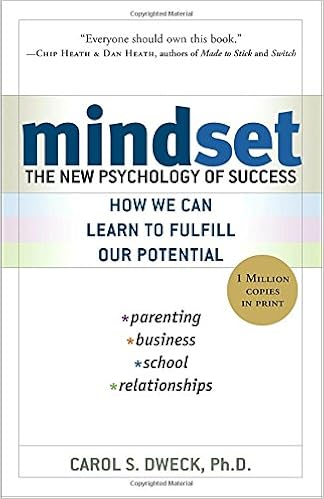
Well, my hope was to do roughly a book per week. However, as one can see, that is not happening. Life (and laziness) has gotten in the way, but alas, I forge on. This review is Mindset by Carol Dweck.
This is a truly outstanding read that contrasts the "fixed" mindset, which judges oneself and accomplishments as a result of inherent traits vs. the "growth" mindset, which evaluates outcomes based on effort, improvement, and other, more relative measures of success. Dweck covers the multitude of drawbacks to the fixed mindset, as well as studies (and anecdotes) to further drive home the points. She also gives small "tests" which help reveal which mindset you currently possess. However, what you will also come to find is that, while you may have the growth mindset, there may be certain areas where you are still very much "fixed." Not to worry, though, as she gives strategies and tips for transitioning toward a growth mindset in all areas. As with anything, the first step is realization, and then comes the hard work. I wholeheartedly recommend it and suggest anyone pick up a copy.
Monday, February 27, 2017
Saturday, February 11, 2017
Fun With Numbers! Part Deux
I wanted to follow up on my post from a few weeks back with regard to working on a running back rating system, based on this paper. The point of the paper is to apply, essentially, the NFL passer rating system to the running back position, utilizing a similar methodology to that which was used to create passer rating, attempting to go beyond simply using rushing yards to declare who the top running back in the league is.
First, the good. The methodology used was sound, as it used a large data pool (all seasons of 1000+ rushing yards going back to 1950), giving them a much larger and more extensive data set than that which was used to create passer rating (which was made, I believe, in 1970). They also incorporated receiving, which I think is helpful, since a running back's true contributions should encompass everything they're doing.
The bad: First, we must operate under the assumption that passer rating is an effective method of evaluating quarterbacks in order to assume that such a rating system should be applied to other positions to begin with. In that regard, I think that it is a decent starting point, and as with any other statistics, cannot be taken in isolation. It is a piece of the puzzle, but it is not the only piece of information we use to judge quarterbacks. Thus, a rusher rating system (I prefer running back rating system, since the rating takes into account receiving as well) is a piece of the puzzle for determining who the best backs are.
Another gripe I have is that receiving essentially receives the same weight as rushing. While I will agree that the receiving aspect is important, by equally weighting it, it punishes those backs who are not large contributors in that aspect, regardless of how good they are as runners. I think that aspect is another one that should be revisited and possibly revised.
Overall, I think it is a good starting point, and if nothing else, gives us another way to look at the players with the data that is readily available (box scores). No, box scores don't tell the whole story and doing something like grading every play, like Pro Football Focus and others attempt to do, is a better approach, but most of us do not have the time or inclination to do so.
Some additions I made were to figure up career ratings for each player, as well as to assign a "Rating+" figure. This is inspired by the ERA+ stat from baseball, in which a pitcher's ERA is adjusted for league and park factors, so that you can compare across eras. For instance, a 3.00 ERA at the height of the dead ball era is completely different from a 3.00 ERA at the height of the steroid era. Thus, by using ERA+, we can begin to compare pitchers from different eras, at least how good they were in relation to their contemporaries.
To do this, I used Pro Football Reference's methodology for their QB metrics, and factored up the player's rating and how many standard deviations above they were, and multiplied the number by 15. This is then added to 100 to give you the Rating+ number. By this metric, holy hell Marshall Faulk.
Additionally, I then calculated 3, 4, and 5 year peak ratings and rating+ figures for each of the players I looked at. This was inspired by the JAWS system or the Jaffe WAR Score, which uses a 7 year peak for baseball players. However, to account for shorter football careers (especially at running back), I shortened it to 3, 4, and 5, just to see where they stood at the peak of their powers.
All in all, it was a lot of fun to do, and it gave me a chance to dick around in Excel and do some fun stuff there. I've also come across a WR rating system that I think I am going to tinker with and do many of the same things when I have some time, as well as going and getting Pro Football Reference's Rating+ numbers for QBs and fucking around with those a bit. If I can figure out how to upload files, I'll upload the Excel file in the off chance anyone ever comes across this and wants to look it over.
Friday, February 3, 2017
Book Review
As if there aren't enough things I'm trying (and failing) to do, I will attempt to post some book reviews as they come along. Recently while listening to an interview with Dan Pfaff, he mentioned that he reads 15-30 minutes every morning and 30-60 minutes every night. 7 days per week. Sometimes related to training and its dependent sciences, other times seemingly unrelated topics. Because Dan is a damn genius, and because I need to read more anyway, I've tried to implement something similar in my own life. Now, there is plenty of work to be done, and there's still boatloads of reading I need to do specific to the training realm, but I'm trying to focus more of my "home" reading on non-training-related topics.
Some of these reviews will be more in-depth, others more surface-level, especially since, as Andreas Behm outlines here, there are levels to one's involvement in books. Some books I will simply be more invested in, and others I will more or less skim. Of course, as Stuart McMillan notes here, I also need to be doing far more RE-reading. But I digress.
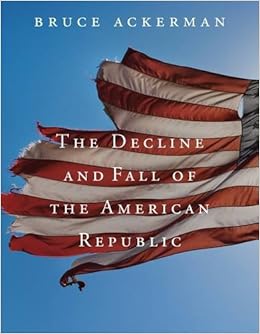
The first book is titled "The Decline and Fall of the American Republic" by Bruce Ackerman.
It was recommended by Dan Carlin on one (or probably many) of his podcasts. It details the progression of the office of the presidency which, due to the myriad steps taken by previous holders of the office, is becoming more of a dictatorship. Essentially, rather than placing, and keeping, constraints in place which permit the checks and balances of the American political system to operate as they should, the presidents have increasingly surrounded themselves with lawyers and lackeys who have found every possible way for them to skirt the laws while progressively increasing their power. I found it especially interesting reading the first few chapters talking about campaigning and how a less-than-ideal candidate may come to power in the first place, and how this progression of power may eventually fuck us (my term). Admittedly my knowledge of the workings of the American political system are limited, however, I found it a very good read and worthy of the time spent. I did not dive in and found myself skimming parts, but overall I would recommend it to anyone.
Some of these reviews will be more in-depth, others more surface-level, especially since, as Andreas Behm outlines here, there are levels to one's involvement in books. Some books I will simply be more invested in, and others I will more or less skim. Of course, as Stuart McMillan notes here, I also need to be doing far more RE-reading. But I digress.
The first book is titled "The Decline and Fall of the American Republic" by Bruce Ackerman.
It was recommended by Dan Carlin on one (or probably many) of his podcasts. It details the progression of the office of the presidency which, due to the myriad steps taken by previous holders of the office, is becoming more of a dictatorship. Essentially, rather than placing, and keeping, constraints in place which permit the checks and balances of the American political system to operate as they should, the presidents have increasingly surrounded themselves with lawyers and lackeys who have found every possible way for them to skirt the laws while progressively increasing their power. I found it especially interesting reading the first few chapters talking about campaigning and how a less-than-ideal candidate may come to power in the first place, and how this progression of power may eventually fuck us (my term). Admittedly my knowledge of the workings of the American political system are limited, however, I found it a very good read and worthy of the time spent. I did not dive in and found myself skimming parts, but overall I would recommend it to anyone.
Thursday, February 2, 2017
Enjoy Every Sandwich
I've tried to employ this mantra on a daily basis - attempting to live in the moment, every moment. Obviously it means to enjoy and savor your food as if it might be your last, but it also means to live in every moment. Not worrying about what is going to happen tomorrow, not worrying about that coworker that pissed you off yesterday. Because in life, that's all we have. What is directly in front of us. If we spend all that time constantly off somewhere else (mentally at least), what are we doing?
Don't misunderstand me, not every moment is going to fit into the popular definition of enjoyable or pleasurable. Nor should it be. In fact, if you are pursuing a fulfilling life, there well may be many moments that are quire unpleasant, and by your own choosing. But if you are along for the ride, if you are aware of the process and aware of the now, there's no reason you can't enjoy it.
Saturday, January 28, 2017
Fun With Numbers!
Lately I've been fiddling around with some rating systems I found to attempt to ascribe a rating (based on the passer rating) to other positions - namely running back and wide receiver (and the receiving portion of tight ends, at the least). They, of course, come with a host of limitations, which I will write about soon, but I wanted to at least get something written. It has been a lot of fun. It has also given me a chance to dick around in Excel and find a shitload of functions that I wasn't even aware of (not that that takes much). Anyway, as the project nears completion, I'll try to put up more about it (methodology, limitations, interesting findings, etc.), and I'll even upload the Excel files if the site will let me.
Friday, January 20, 2017
For All The Dads Out There...? Nope, Just For Me
A few months ago, I was passed along a blog that my wife had
come across that was “for all the moms out there.”
This is my attempt at an addendum to that piece, because it
was fantastic.
I don’t write this for “all the dads out there,” because I
wouldn’t pretend to speak for the experience of all, or even most, other men.
We all have our own visions, experiences, goals, dreams, values, morals, and
views on what being a father even means. But I can at least shed light on my
experience.
Every day is a struggle. Not in the sense of struggling to
keep a roof over our heads or keeping food on the table; the type of struggle
most people refer to when using that phrase. No, my struggle is an internal
one. One where my actions and outcomes are at odds with my goals. I’m
constantly asking myself, “what kind of example am I setting for my kids?” Not
because I’m doing things that are immoral or that most would condemn, but
because I’m not making the most of my life. I’m not living up to the words I
speak.
When I began writing this piece, I was working a rather
menial job. I would think to myself, “I have a master’s degree and am in a job
that can be performed by damn near anyone. I’m earning a middling income. Because
of my work hours, I not only do I not see my kids in the morning, but I don’t
get to help and support my wife in raising them. Not that I think it’s OK to
not be around, but at the very least I would find it slightly more acceptable
if I were making boatloads of money.”
Even now, my goals, both professionally and personally, are
set much higher, but I feel like I don’t know how to reach them. I want to feel
fulfilled through what I’m doing, while providing a financial environment for
my family that provides comfort and, hell, excess if possible.
I know there is untapped potential and that I can do so much
better for myself and my family.
But getting away from my own inadequacies and back to the
point at hand.
I want to raise intelligent, curious, assertive,
conscientious, thoughtful, tough, resilient children. I want them to experience
success, joy, opportunity, all the things parents want for their children. In
some sense, I never want them to feel pain. As Joe Rogan puts it, I want to
“Nerf the world.”
But I also want them to experience failure, disappointment,
rejection, and yes, pain. To know that, while if they work their ass off for
something they can achieve it, that
does not guarantee that they will
achieve it. And that that’s OK. That it doesn’t mean to simply not try.
There are stories and anecdotes abound about authors, sports
stars, movie makers, and more who failed time and again before they finally got
their big break. And while these stories are shared ad nauseum, often in trite
motivational memes in an effort to get people moving, they also serve to show
that failure is frequent, it is probably inevitable, it is definitely OK, and I
might dare say even required for success.
We simply can’t Nerf the world – not
only because of feasibility, but because in doing so, we are doing our kids a
disservice.
I don’t want them to fail for the sake of it. I want them to
fail because the time isn’t right. I want them to fail because sometimes things
just don’t work out, despite your best efforts. I want them to fail because
maybe they didn’t actually work hard enough to earn it. But I also want to be
there to grab them, hold them tight, wipe away their tears, and tell them,
“it’s OK. Get up and try again.” And, even more importantly, to know that they
will. And to know that every time after that, I won’t even have to tell them.
It’s hard. Good lord, is life hard. You’re juggling the
responsibilities to your family (financial, emotional, physical) with your own
personal and professional goals. Yes, you have to put your own wants and needs
on the backburner, because your kids’ needs come first. But a better you also
ultimately equals a better them. When you’re not feeling fulfilled yourself, it
becomes that much harder to make those around you feel fulfilled, and help them
be the people they want to be.
But every time I think about how “hard” life is, I am
reminded of the quote by Sydney Harris, “when I hear somebody say ‘life is
hard,’ I’m tempted to ask, ‘compared to what?’” Yes, life is hard. But it’s
hard for everyone (harder for some than others, yes). But, I think there is an
important teaching point in there for the children – you’re going to have to
work damn hard to get what you want. Resilience, fortitude, creativity, passion
– you’ll need all of it, and more, to live the life you want.
Sometimes you look at them and it seems like they’re never
going to get older. They’re always going to be that age. And then they do
something that reminds you they’ll never be this age again.
So grab it, cherish it, immerse yourself in it. It’s easy to
lose sight of that. Our frustration and anger often come when there is a
misalignment between our expectations and the present reality. The kid isn’t
going to sleep like they’re supposed to, they’re not listening, they’re not
eating. Remember that your timeline is not theirs. Remember that they are
trying to figure this all out, too. And most of all, remember that you love
them and losing your patience does no one any good.
Someday, maybe, I will be able to make it reality. Until
then, I struggle on…
Wednesday, July 20, 2016
Satisfaction
Being able to resist short-term satisfaction is very hard for a variety of reasons. While I won't pretend to know the science behind it, from an evolutionary perspective, it makes perfect sense. In the past, if we decided to fulfill a short-term interest that didn't coincide with survival, such as finding food, we were quickly met with, at best, sharp hunger pangs, and at worst, death via starvation. However, we now have nearly every facet of the bottom rung of Maslow's hierarchy of needs at our fingertips. We no longer have to forgo other urges in order to feed ourselves. The food is readily available. It becomes paramount that you develop the discipline to stave off what Seth Godin refers to as the "lizard brain." It's fear that will masquerade as boredom. It's that voice telling you you have better things to do. That you can't/won't make a difference.
You have to identify what it is that causes you issues and cut it off at the pass. The internet, as great as it is for connecting us and providing information, also provides a great "escape" and avenue for sucking away time. You may have to disconnect your internet. There are even programs you can get that will do it for you at certain blocks of time that you set. You may have to somewhere that doesn't have internet access. Whatever it takes.
Plan your day. Taking the time to plan your day and then having the discipline to follow it through will make a world of difference. I don't remember which business book or blog I read it in, but one of the best pieces of advice I've seen is, "you should never wonder what to do next." Have a backlog of ideas and projects and things to do. This doesn't just mean busywork (though sometimes that's necessary). It means have your meaningful work scheduled, lined up, and ready to go, then carry it out.
You have to identify what it is that causes you issues and cut it off at the pass. The internet, as great as it is for connecting us and providing information, also provides a great "escape" and avenue for sucking away time. You may have to disconnect your internet. There are even programs you can get that will do it for you at certain blocks of time that you set. You may have to somewhere that doesn't have internet access. Whatever it takes.
Plan your day. Taking the time to plan your day and then having the discipline to follow it through will make a world of difference. I don't remember which business book or blog I read it in, but one of the best pieces of advice I've seen is, "you should never wonder what to do next." Have a backlog of ideas and projects and things to do. This doesn't just mean busywork (though sometimes that's necessary). It means have your meaningful work scheduled, lined up, and ready to go, then carry it out.
Subscribe to:
Posts (Atom)